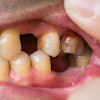
A wise patient once told me, "If it’s not in your face, it’s in a case." I’ve lived by that mantra ever since. Removable dental appliances can become lost for all patients of all demographics, but with vulnerable populations, such as patients in skilled nursing facilities (SNFs), it can lead to devastating consequences.
 Dr. Alexis Lee.
Residents in nursing homes are already one of the most underserved populations, so getting any form of dental treatment, even simply comprehensive exams, is very difficult. When a denture is lost, it can take months for a replacement to be delivered to the patient.
This delay is due to the high volume of patients us mobile dentists must see. We are usually only able to be contracted to work with labs that can accommodate hundreds upon hundreds of removable cases. This inevitably causes a delay in treatment compared to a traditional private office.
Another consideration is that, oftentimes, when a patient is discharged from a SNF, they do not receive any dental care at all. They may not have a mode of transportation to a private office, the private office may not be able to accommodate patients who cannot transfer into a dental chair, and patients may have a chronic disability, whether it is mental or physical.
There are many reasons why underserved populations are unable to receive care. It is not always due to the common misconception of finances or lack of motivation.
Additionally, even if a patient is approved and ready for a new prosthesis, they may face other problems, such as resorbed bone from not wearing their dentures for an extended period of time. There is also the issue of teeth becoming decayed or broken, as oral health is not a top priority in SNFs. Therefore, patients may need other treatment, such as fillings or extractions, before they start the process of getting a new prosthesis.
Yet another hurdle is that these patients, especially long-term patients, may have severe disabilities such as dementia or oral myofunctional disorders that they didn’t have when they got their current set of dentures. These issues make it nearly impossible to get a quality impression or bite registration.
Patients may be unable to sit up, follow directions, or move their jaw properly. This leads to ill-fitting prostheses despite doing everything in our power to have both functional and aesthetic dentures.
How do dentures get lost? If they are not in their face and not in a case. Many patients may be rushed to hospitals for surgeries or other problems that involve long stays in the intensive care unit.
I can understand that with so many moving parts, dental health may be the last thing on the minds of hospital employees and family members. Which, I must add, is normal and is nothing to be ashamed of at all.
People can survive without teeth. They may not survive, however, or have a good quality of life with damaged organs such as the eyes, heart, lungs, or kidneys. I believe that dental care should come last in many situations.
However, if a patient already has dentures -- full or partial -- it is of the utmost importance for the prostheses not to get lost due to the complications explained above. I believe education for hospital employees and patients' families would be the best way to prevent dentures from being lost.
If everyone knew the mantra of "If it’s not in your face, it’s in a case," I firmly believe the number of dentures being lost would dramatically decrease.
I understand it is often necessary to remove dentures during surgeries, especially in protecting the airway during IV sedation or general anesthesia. Additionally, dentures made with metal may need to be removed for radiographs.
There is no feasible way that dentures can "be in the face" of all patients in certtain instances. Therefore, it absolutely "needs to be in a case," ideally one labeled with the patient's full name and date of birth.
I believe this could be relatively easy to implement by adding it to the checklist manifesto that surgeons and other hospital staff follow. Two simple questions -- "Does the patient have dentures?" and "Is it in a case?" -- may truly benefit all patients, especially those who are part of the underserved population.
Better yet, family members or other capable friends should consider leaving the dentures at home before going to the hospital. However, some people do not have reliable family members or friends. Therefore, adding it to the checklist manifesto could work even better. All in all, yes, patients can survive without their dental prostheses, but I believe there is a simple solution to this problem.
One last caveat -- and this is a major one -- many government-funded insurance plans only cover dentures every five years. If a patient needs to wait five years before they can get another denture, it is highly likely their teeth may need extensive treatment and/or there will be a loss of ridge and collapsed vertical dimension of occlusion, which would prevent even the best dentists from ever making a prosthesis as good as the one they had before.
And finally, I must mention the worst-case scenario, that patients do not survive. However, I think it's still ideal for patients to be wearing their dentures when they pass on to preserve their dignity as much as possible … in whatever type of afterlife they may believe in.
Dr. Alexis Lee is a San Francisco Bay Area native and is a graduate of the University of the Pacific Arthur A. Dugoni School of Dentistry. She also received her Bachelor of Arts degree in rhetoric from the University of California, Berkeley. Since becoming a dentist, Lee has never forgotten her love of reading and writing and is excited to incorporate dentistry into her journey of becoming an established author.
The comments and observations expressed herein do not necessarily reflect the opinions of DrBicuspid.com, nor should they be construed as an endorsement or admonishment of any particular idea, vendor, or organization.